Accessibility on trains

Accessible train travel

none

Discovering Spain by train is a comfortable, sustainable and increasingly accessible experience. Thanks to one of the most modern rail networks in Europe and a strong commitment to inclusiveness, train travel in the country allows you to explore historic cities, natural landscapes and cultural destinations with autonomy and peace of mind, whatever the needs of each traveller.If you are looking for a destination where accessibility is part of the tourist experience, Spain offers a ready and reliable environment. Find out more here!

Are trains in Spain accessible?

Yes. High-speed, medium and long-distance trains (including commuter trains) and the country's main stations are adapted to facilitate travel for people with disabilities or reduced mobility. They also offer assistance services.

What services are available for people with disabilities?

Adif Acerca is a free care and assistance service for people with reduced mobility or visual, hearing or cognitive disabilities. This can be requested when purchasing the ticket or up to 30 minutes before the train departs and provides accompaniment and support at the station and on boarding. Some of its features include:- Access to a wheelchair to move around the station.- Technical support for better communication for the hearing impaired.- Assistance in getting on and off the train and help in finding the seat for visually impaired passengers.- Guidance and accompaniment through the station to their seat for people with intellectual disabilities or comprehension difficulties.Renfe (Red Nacional de los Ferrocarriles Españoles), the main public rail transport company in Spain, provides service centres at most large and mid-sized high-speed and long-distance railway stations. These are facilities that provide human and technical support and facilitate before, during and after the trip. Here is a map of the stations with assistance services.These services are available for both AVE trains and Avlo low-cost trains.

All other rail operators are also adapted to offer accessible travel.Ouigo, for example, has adapted seats for passengers with reduced mobility, which must be selected when purchasing the ticket. It also allows a seat for an accompanying person to be reserved near this seat. Plus, it has an assistance service that can be booked up to 12 hours before the train departs. It is advisable to arrive at the station one hour in advance to receive appropriate assistance. This service is available for:- Wheelchair travellers.- Travellers with mobility difficulties and in need of a transit wheelchair.- Travellers with visual and/or hearing impairment.- Travellers with intellectual disabilities or comprehension difficulties.- Travellers with reduced mobility in need of assistance, such as people with a pushchair or pram, or pregnant or elderly people.In addition, passengers with reduced mobility and/or disabilities have priority access to boarding.Trains operated by Iryo are also designed to be accessible and comfortable to travel on. They have 2 specific spaces for customers travelling with their own wheelchairs. For a more personalised service, you can contact their customer service number: 910 150 000

How can I buy a ticket if I have a hearing or visual disability?

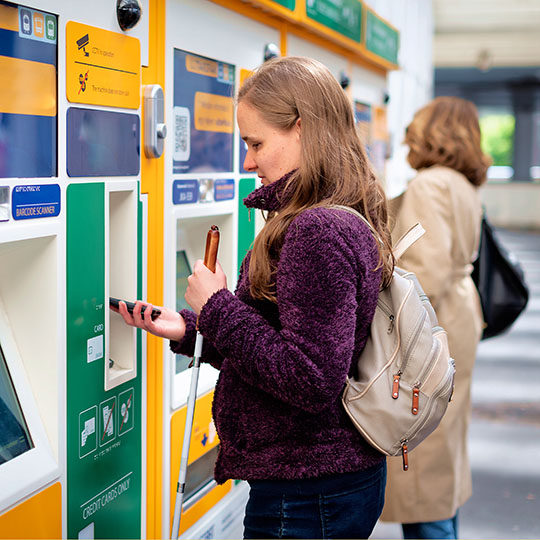
Visually impaired passengers have access to Renfe's free phone helpline 900 400 555 for help purchasing tickets and to request assistance services. It allows the purchase, exchange and cancellation of tickets, as well as requesting assistance at the time of purchase.In addition, these travellers can travel with their guide dogs on any rail operator in Spain.Likewise, Renfe passengers with hearing disabilities also have a video call service available. Service is provided in sign language and tickets can be purchased, exchanged and cancelled. All other operators also offer adapted communication for passengers with hearing needs.

Visually impaired tourist buying a train ticket

How do I know which stations are accessible?

Improving accessibility is one of the four main lines of work in train stations in Spain. Thanks to continuous work in this area, travellers have access to, among other services:- Visual and auditory traveller information systems.- Access ramps to platforms and vestibules.- Accessible and reserved parking for people with disabilities.- Accessible routes.- Proximity strips and yellow stripes on the platform edge to be detected by visually impaired passengers.- Non-slip rubber steps and ramps and hoists on platforms.- Adapted toilets- In addition, the stations are staffed with trained personnel to attend to the needs of passengers.Search here to find accessible stations and the services they offer.

How many stations have care and assistance for persons with reduced mobility?

Currently, more than 600 mobility assistants wearing orange uniforms provide assistance to passengers with disabilities and reduced mobility at some 146 stations throughout Spain. Some stations also have the Svisual sign language interpreting video system.

Will I be able to travel comfortably on the train?

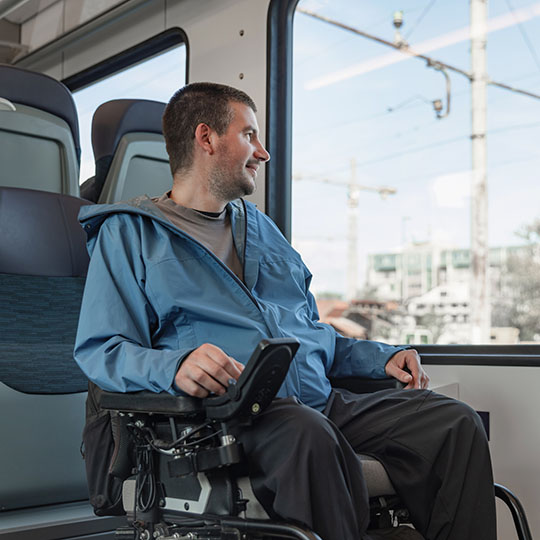
Yes. Trains offer comfort, stability and services designed for all travellers. Unlike other types of transport, most trains in Spain have:- Spaces reserved for wheelchairs, located in specific carriages and with folding tables.- Adapted toilets on long distance trains.- Visual information and audio warnings during the journey.- Attention by trained staff.

Accessibility on trains

Which accessible train routes allow you to discover Spain?

It is possible to travel comfortably throughout most of Spain, as most of the high-speed, long-distance and suburban trains are accessible to any traveller.From Madrid, for example, in an average of two and a half hours, you can travel and enjoy the landscapes, cuisine and architecture of other major Spanish cities such as Barcelona, Seville, Valencia and Málaga.In addition, accessible train options also include cultural and scenic routes. This is the case of the Cervantes Train and the Tren dels Llacs, the panoramic version of which has full accessibility and spaces reserved for people with reduced mobility.


Find out more about...