A close-up of a slice of Guijuelo Iberian ham

A journey to enjoy Guijuelo Iberian ham

Salamanca

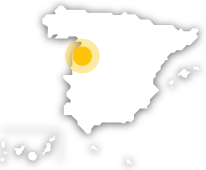
Whether you enjoy Iberian ham, want to learn about how it’s traditionally made, or are keen to find out where the pigs are reared, this route offers you the chance to do just that in the south-east of Salamanca (in Castille and León). This is where Guijuelo Iberian ham is produced; it is one of the four Protected Designations of Origin for Iberian ham in Spain and the first to be recognised as such. And if you haven’t yet tried Iberian ham, or aren’t sure whether you’ll like it, this is a great opportunity to do so and learn about the labour-intensive process behind this authentic culinary delight.Guijuelo Iberian ham is mainly produced in the municipalities of Guijuelo, Béjar and Candelario. A route of just over 30 kilometres through unspoilt countryside in the Sierra de Béjar, featuring vast pastures of cork oaks and holm oaks. The route is the perfect day trip, and its proximity to the cities of Salamanca (about an hour’s drive away) and Madrid (about two and a half hours’ drive away) makes it easy to enjoy.

The route: Guijuelo – Béjar – Candelario

The area is home to more than 150 companies specialising in ham and cold meats, and some of them offer tours of their facilities and activities such as tastings or trips to the pastures where the pigs are reared. Guijuelo is home to the Chacinera Industry Museum, a great place to gain an in-depth understanding of the area’s ham-making tradition. The fortified tower (the apse of an old church on the outskirts) and the main square (where a popular market is held on Saturdays) are its two main attractions. February is a good month to visit Guijuelo because at the weekends it hosts the ‘Jornadas de Matanza Típica’, the regional festival centred around pork. In autumn, the pigs roam almost freely through the pastures, feeding on seasonal fruits such as acorns and chestnuts, as well as other plants.

Museo de la Industria Chacinera (Cold Meats Industry Museum) in Guijuelo, Salamanca, Castile and León

Béjar is not only a fantastic starting point for a day out in the countryside or a day’s hiking in the Sierra de Béjar, but also a small town rich in historical monuments, notably the Ducal Palace, its large park, El Bosque, and its city walls. In June, the town celebrates the Procession of the Men in Moss, a unique parade held to mark the Corpus Christi celebrations.The route can end in Candelario, one of the prettiest villages in Castille and León, which is well worth exploring on foot as you wander through its steep streets. Its traditional architecture, its well-preserved network of narrow streets and its peaceful atmosphere make a visit here a special experience. This is where the Casa Chacinera Museum is located, dedicated to the pig-slaughtering tradition.

What is Guijuelo Iberian ham like, and what makes it so special?

Iberian ham from Guijuelo is renowned for being mild and very creamy. The climate in the area, with cold winds and short summers, is ideal for curing the ham naturally and using less salt. This means that Guijuelo Iberian ham can have a sweeter flavour than other hams. Furthermore, the pigs are fed a diet of acorns, which gives the hams a high content of oleic acid and other fats that are beneficial to health. This route is for you if, as well as enjoying a tasting of Guijuelo ham, you want to discover how it is made and learn about the region and the traditions behind this product.

Free-range Iberian pigs in Guijuelo, Salamanca, Castile and León

FAQs

What is Guijuelo Iberian ham?They are individual cured legs from Iberian pigs which, after being salted, are left to cure for a minimum of between 24 and 33 months in the mountain air of this area of Salamanca.Why is Guijuelo Iberian ham so highly prized in Spain?Because it is a high-quality product, produced as a result of years of careful rearing, with the animals fed on acorns and other plant-based foods, and the hams then cured naturally in a controlled environment. All of this gives the hams an exquisite aroma, flavour and texture.How does the Iberian pig differ from other breeds?They are slightly smaller than most pig breeds, with a metabolism that naturally distributes body fat throughout the muscles (intramuscular fat). These are animals that live in semi-freedom for much of their lives.How can you get to the Guijuelo area from Madrid and Salamanca?There are several bus routes running from the city of Salamanca to the settlement of Guijuelo and the rest of the district.  You can also travel from Madrid to Salamanca by bus and high-speed train, with several services a day. Both cities are linked by the country’s motorway network, specifically the A-66, known as the Autovía de la Plata.  

#spanishfood