Five destinations 'discovered' by our travellers on social media
Spain's natural, heritage, and cultural wealth is so immense that it's often possible to experience the feeling of discovering unique places. These are lesser-known destinations and, therefore, usually uncrowded despite their great beauty.Here are five recommendations that our users have shared on their social media. Let's find out why they are so special and why they have captivated them. Pack your bags and join us!
-
Paraje de Castroviejo (Duruelo de la Sierra, Soria)
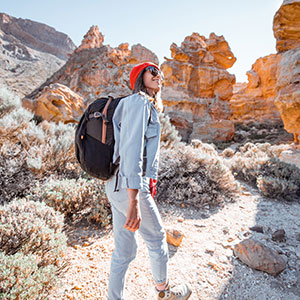
For millennia, wind and water have sculpted the rocks of the natural beauty spot of Castroviejo, in the northwest of the province of Soria, creating picture-perfect silhouettes. This area is part of a natural landscape that you'll love to photograph: the Sierra de Urbión mountain range.- What makes it special: it has a viewpoint from which to admire extensive pine forests and charming little villages. You can walk across the waterfall that cascades into the Cueva Serena and, a little further on, admire the La Chorla waterfall.- How to get there: it is about 45 minutes from Soria by road, accessible via the CL-117 from the N-234. There are daily buses from Madrid to Soria (about a two-and-a-half hour journey).- Bonus: just 10 kilometres away is the source of the Duero River, and very close by are the spectacular Laguna Negra and the Glacial Cirques.
-
Orbaneja del Castillo (Burgos)
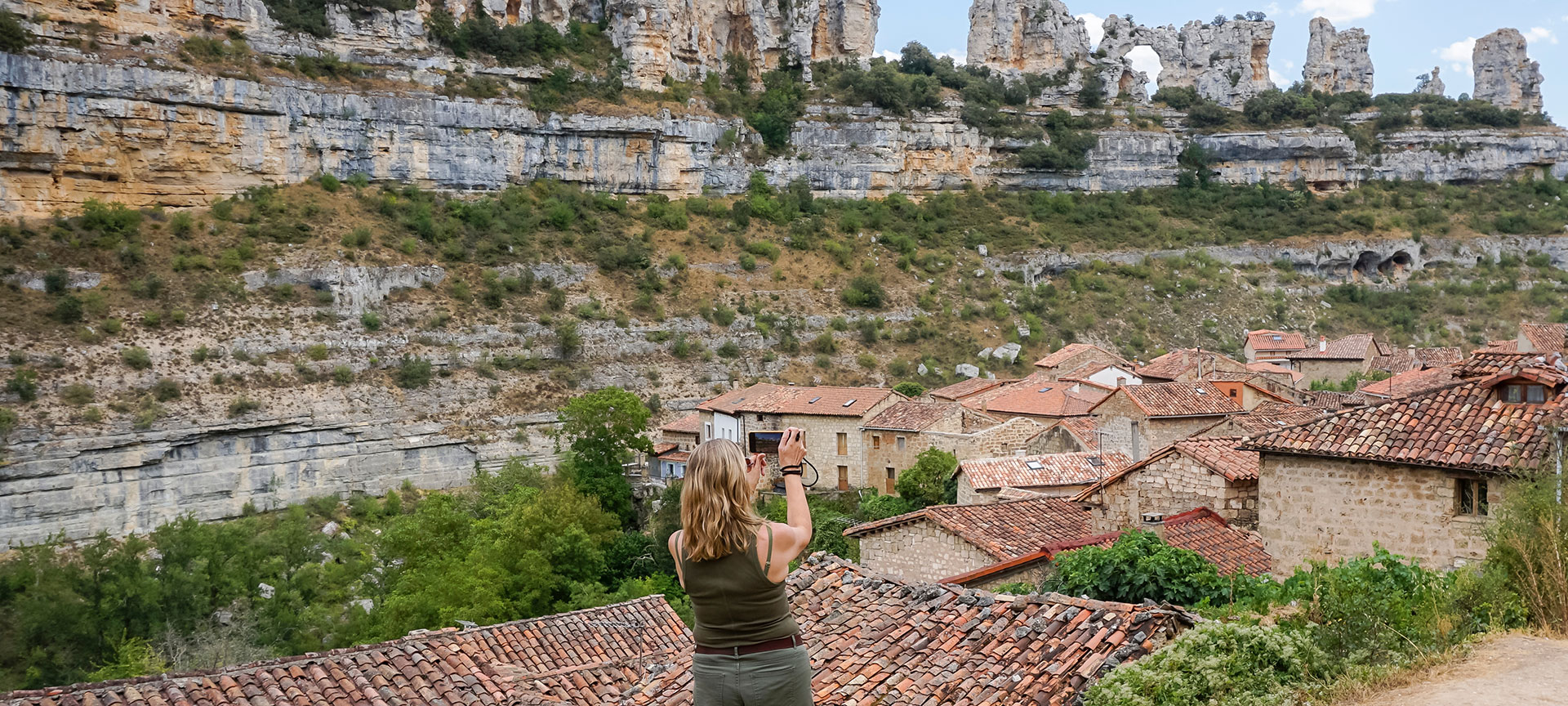
In the province of Burgos lies the small town of Orbaneja del Castillo in the heart of the Ebro River Canyon.- What makes it special: the wooden façades and balconies of its houses and cobbled streets, the 25-metre-high waterfall that greets you upon arrival, and the Cueva del Agua, from where the views are picture-perfect.- How to get there: it takes less than two hours to get from Madrid to Burgos by high-speed train . There are also daily buses from the Spanish capital to the city of Burgos and from there to Venta Orbaneja, a couple of kilometres away. By road, it's an hour from Burgos via the BU-643 regional road from the N-623, and about two hours from Bilbao (with an airport offering international flights) via the CL-629.- Bonus: just 10 kilometres away you can visit the beautiful Collegiate Church of San Martín de Elines in Valderredible (Cantabria), considered a jewel of Romanesque architecture.
-
Valderrobres and the Matarraña Region (Teruel)
To the east of Aragon, you can explore the charming Matarraña region, made up of 18 municipalities brimming with green landscapes and fascinating corners like Beceite. Valderrobres and Calaceite are part of the group of the Most Beautiful Villages of Spain.- What makes it special: It's ideal for family trips, as you can enjoy peaceful walks, swimming in the pools of La Pesquera, or cycling along the Val de Zafán Greenway. The cultural offerings are extensive, with Levantine rock art, medieval burial mounds, Gothic art routes, and nearly 40 museums, interpretation centres, art galleries, and even visits to old prisons and their dungeons.- How to get there: you can travel by high-speed train to Tarragona or Zaragoza and then take the bus to Alcañiz, the main means of public transport to the region. The access roads are the N-420 and the N-232.- Bonus: there are many marked routes and trails for horseback riding. From the Crystal Stables in Valderrobres, you can take guided excursions and even an original wine tour. Imagine exploring archaeological sites and vineyards and enjoying a tasting and a gourmet lunch prepared by a local chef?
-
Castellfollit de la Roca (Girona)
Those who have visited Castellfollit de la Roca, in Girona, have fallen in love with this village perched atop an imposing rock face over 50 metres high and almost a kilometre long.What makes it special: along a circular route, you can explore the streets of the medieval old town, visit the ancient church of Sant Salvador, and reach breathtaking viewpoints. The main tourist attractions are signposted in Braille.- How to get there:Girona and Barcelona are the closest cities accessible by high-speed train or bus. By road, it is 45 minutes from Girona via the A-26 and less than two hours from Barcelona (both have airports with international flights).- Bonus: just a few minutes away is the Garrotxa Volcanic Zone Natural Park, with almost 40 volcanic cones and 20 lava flows.
-
Bolvonegro Strait (Moratalla, Murcia)
Inland in Murcia lies the Bolvonegro Strait, very close to the town of Moratalla. It is a winding gorge with vertical walls, between the Alhárabe and Benamor rivers, with a wealth of geological features, waterfalls, and crystal-clear pools.- What makes it special: its colours, textures, and the contrast between the rocks and vegetation are striking. As well as enjoying the tranquillity, it's a fantastic place for hiking and nature photography.- How to get there: by high-speed train to Murcia and from there you can take a bus, which takes just over an hour and a half. By road, it's an hour from Murcia, accessible via the RM-714 from the A-30.- Bonus: visit the Casa de Cristo Interpretation Centre in Moratalla and take a guided tour to explore one of the largest collections of Mediterranean rock art in Spain.
If this trip to lesser-known corners has inspired you, at Spain.info you'll find many more amazing places that will encourage you to continue exploring Spain and share them on your social media. Come and discover them!

Book yours
Choose between thousands of activities to live your best life on holiday.